
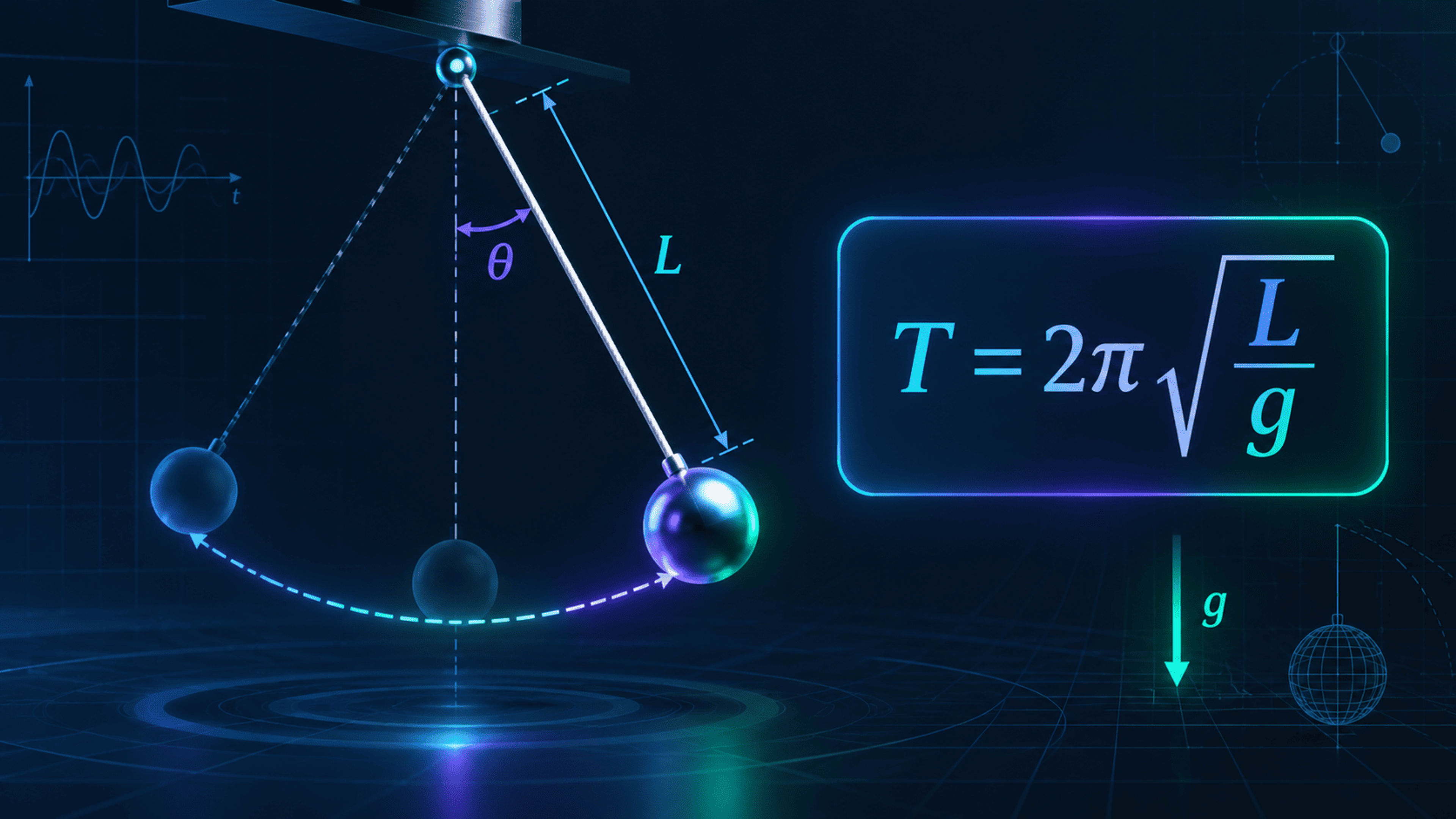
The simple pendulum period formula is T = 2π√(L/g). It predicts the time for one complete oscillation when a point-like bob swings through a small angle on a light, fixed-length string. The ideal period depends on length and gravity, not on the bob's mass.
This is an approximation, not an exact equation for every pendulum. Use it to make a prediction, then compare that prediction with the small-angle model in Pendulum Lab.
What the variables mean
T: period, the time for one complete cycle [s].L: distance from the pivot to the bob's center of mass [m].g: gravitational acceleration magnitude [m/s²]. This example uses 9.81.π: the dimensionless constant pi.
Inside the square root, L/g has units of seconds squared. Its square root has units of seconds, as a period should. If a problem gives centimeters, convert them to meters before combining length with gravity in m/s².
Period and frequency describe the same repetition in different ways: f = 1/T, where f is measured in cycles per second [Hz]. Angular frequency is ω = √(g/L) = 2πf, measured in radians per second [rad/s]. It is not numerically the same quantity as frequency in Hz.
Why the small-angle formula works
Gravity provides a restoring effect that turns the bob toward its lowest position. For a simple pendulum, the angular equation is d²θ/dt² = −(g/L) sin(θ). At small angles measured in radians, sin(θ) ≈ θ, so it becomes d²θ/dt² = −(g/L)θ.
That linear equation describes simple harmonic motion with angular frequency ω = √(g/L). One cycle advances the oscillation phase by 2π radians, so T = 2π/ω = 2π√(L/g).
If the bob is released from rest at its initial angle θ₀, the undamped approximation is θ(t) = θ₀ cos(ωt). The familiar cosine shape connects this motion with Math Sine Wave Lab, although that graph Lab uses its own linked frequency parameter rather than deriving frequency from L and g.
Assumptions and limits
The formula assumes a light string, a point-like bob, a fixed pivot, constant gravity and negligible resistance. It also assumes a small angular displacement. A 10° release is a useful starting experiment; increasing the angle makes the linear approximation less accurate. A larger amplitude does not make the exact physical pendulum's period strictly unchanged.
Pendulum Lab uses the small-angle model and warns outside its approximation range. Its optional damping changes the displayed amplitude over time; the period readout remains the ideal small-angle reference. Turn damping off when checking the formula below. A rigid rod or extended object is a physical pendulum and needs a different treatment that includes its mass distribution.
Worked example: a one-meter pendulum
Set L = 1.00 m and g = 9.81 m/s². Use a 10° initial angle and zero damping for comparison with the Lab.
T = 2π√(1/9.81) ≈ 2.006 s
The frequency is f = 1/2.006 ≈ 0.4985 Hz, and angular frequency is ω = √9.81 ≈ 3.132 rad/s.
One complete cycle runs from one side back to the same side with the same direction of motion. Moving from one extreme to the opposite extreme takes about half a period, or 1.003 s here. Crossing the lowest point for the first time after release takes about a quarter period, or 0.502 s.
At the lowest point, the angle is zero but the bob is moving fastest. At an extreme, its instantaneous velocity is zero while gravity still supplies a restoring effect. Position and velocity are different parts of the motion.
What length, gravity and mass change
For two pendulums in the same gravity, T₂/T₁ = √(L₂/L₁). Changing length from 1 m to 4 m doubles the period to about 4.012 s. Doubling length would increase the period by √2 rather than doubling it.
At fixed length, a larger g produces a shorter ideal period because T ∝ 1/√g. These square-root relationships help predict the direction and size of a change before running an experiment.
The bob's mass cancels from the ideal angular equation: a heavier bob has both a larger gravitational restoring effect and proportionally greater inertia. Changing mass alone therefore does not change this ideal period. Real strings, friction and air resistance can introduce effects beyond the model.
You can also compare period and frequency in Wave Lab. That Lab describes a traveling pattern with independently editable frequency and wavelength, rather than a pendulum whose frequency follows from length and gravity.
Common mistakes
- Measuring L as just the exposed string instead of pivot-to-bob-center distance.
- Mixing centimeters with g in meters per second squared.
- Counting a one-way swing as a complete cycle.
- Treating f and ω as interchangeable;
ω = 2πf. - Assuming the small-angle formula is exact at large angles or proves all damped systems keep the same period.
- Expecting a change in bob mass to alter the ideal period while L and g stay fixed.
Compare the prediction in the Lab
Open Pendulum Lab and enter L = 1 m, g = 9.81 m/s², an initial angle of 10° and damping zero. Inspect the ideal period and frequency, play the motion, and compare one full cycle with the predicted 2.006 s.
Reset and change only length to 4 m. Predict twice the period before checking the readout. Then change mass while keeping the other settings fixed and check that the ideal period stays the same. Enter these settings manually; the article link does not preload them.
For the textbook derivation and the distinction between simple and physical pendulums, see OpenStax: Pendulums.
Try it in the Lab
Set length to 1 m, gravity to 9.81 m/s², initial angle to 10° and damping to zero. Compare the ideal period, then try a 4 m length. Enter these settings manually.
Try the Pendulum Simulator